The
Swing of a Gourd
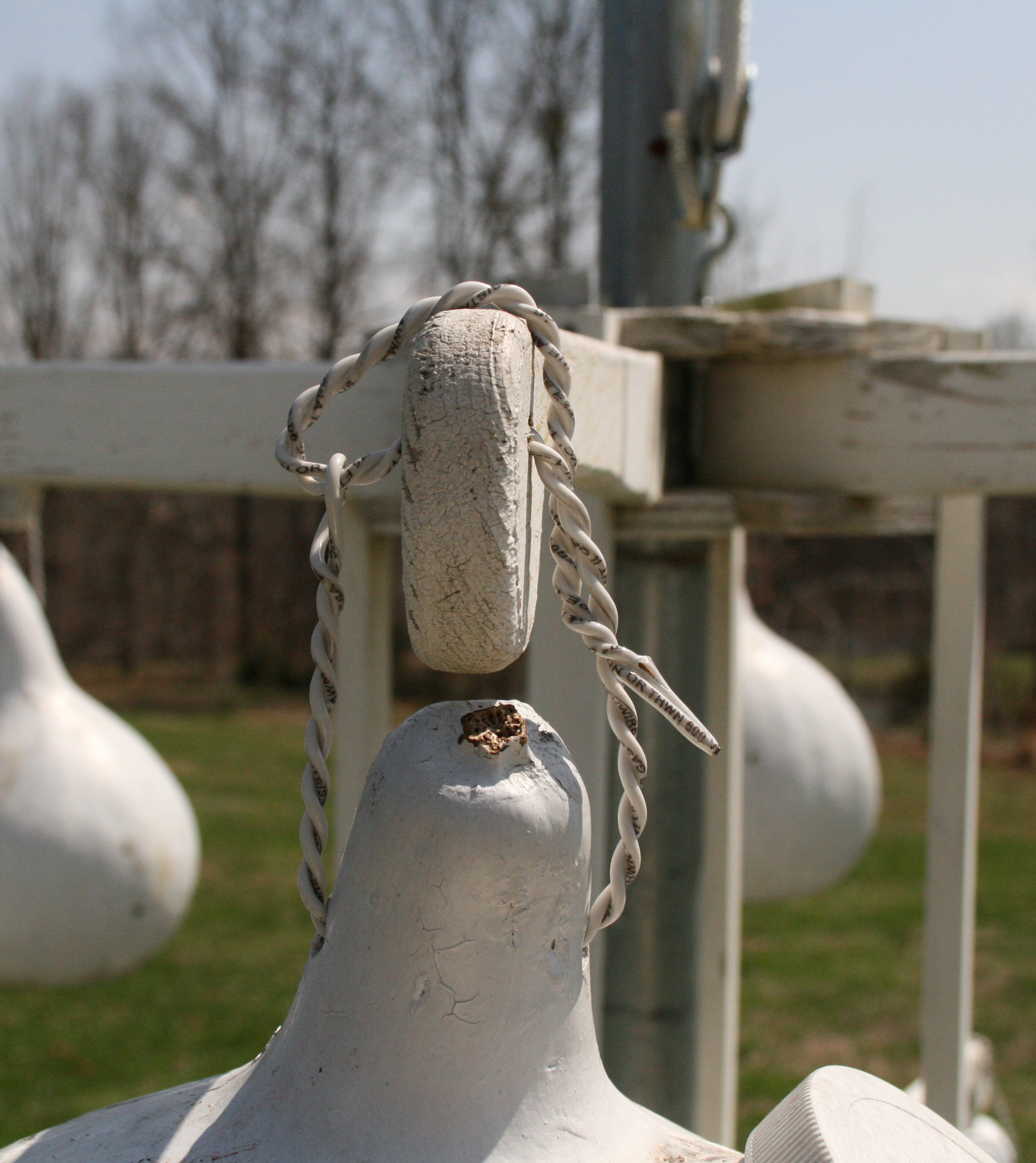
I've been asked a number of times about the method I use to tie my gourds to my racks and about the excessive amount of swing that can take place because of it. In most of those questions, I'm asked about whether or not I'm worried about the contents inside the gourds being tossed out. The answer is NO!
I've done a fair amount of observation of my colony and the gourds used in it and the following is why I tie my gourds and let them swing the way I do. For those that haven't seen my picture before, I tie my gourds using twisted 14 gauge coated solid core electrical wire. In my following explanation, I'm going to approach it from an engineering standpoint. And also, the way I hang them cuts way down on the fatigue of the wire and they can be used for many years before needing replacing. Fatigue of the wire ‘in any situation’ can result in a gourd coming down and that’s something you don’t want.
And let me also add here: You will get different answers about hanging gourds from just about everyone you talk to on the subject. Each landlord has their own reasons for hanging them the way they do. Some like them rigid. Some like me, like to let them swing. The following are my reasons.
The swing of a gourd, when hung at
the top as shown above, is actually good for a number of reasons.
No, it doesn't prevent any other kind of bird from nesting in them, that's just a myth and someone's wishful thinking. It also doesn't prevent any
kind of predator from attacking the gourds. Only properly installed predator
guards will do that.
The swing of a gourd means that it's 'hinged', so to speak, at the top, thus bringing the laws of centrifugal
force and momentum into play. (Not so with hard mounted gourds,
which I'll explain). If a sudden movement or jolt of the mounting
structure such as a T-bar, rack, house or whatever form of housing is used (and from this
point on, called 'rack') occurs, the top of the gourd follows with
it. However, the bulb of the gourd does not. One of
the laws of physics says that, bodies in motion tend to remain in motion and
bodies that are at rest tend to remain at rest until acted upon by
another outside force. But then, everybody knows all that stuff from
high school, so back to the swing of the gourd.
Any outside force on the rack causes it to sway back and forth, usually in the direction the force comes from. This swaying of the rack moves the top of the gourd while the bottom (bulb) only moves slightly, usually only tipping slightly to match the movement of the top. Normal bumps or wind actions on the rack will set up a rhythm of the rack and if not continued, the rack slowly returns to normal. The hinge (at the top of the gourd) stays with the rack while the bulb actually stays somewhat in place. So in reality, the contents of the gourd do not move around as much as most fear.
Note here:
I actually have a camera in a gourd and have watched what happens to the contents of the gourd on very windy days and thus, I can make the above statement with a high degree of confidence.
If the motion is continuous and consistent, then the gourd
bulb simply sets up a sort of back and forth tipping action and really doesn't
move that much. However, if the motion becomes stronger, such as a high
wind can cause, this causes the gourd bulb to begin to swirl and also sets
centrifugal force into motion. This tends to make the contents inside
stay put simply because of the nature of the force. The bowl tends to tip
in the direction ‘normal’ to the force and thus, the contents tend to remain in
place. This can only happen with gourds that are allowed to swing in any direction, such as the way I let mine swing.
However, if a gourd is hard mounted, (and this applies for all hard mounted housing), then the contents of the gourd are at the mercy of the mounting structure and the back and forth momentum of that structure causes the contents to bounce and bump around. A sudden jolt or movement of the house or rack with a hard mounted gourd will mean the nest, which is usually packed into the compartment and is essentially hard mounted itself, will want to move with the house or gourd, but the contents of the nest, being loose, will not. It's kind of like yanking a tablecloth out from under the place settings. If the nest is moved drastically out of the way, the nest contents, because of momentum, will want to remain in place and thus, will be forced out of their nest and unfortunately, will be thrashed about the compartment. The nest cannot tip to accept the force such as with a gourd that is allowed to swing. Centrifugal force of the nest cannot become a factor in such a case, but momentum of the nest contents, can. The faster the motion of the mounting structure, the more momentum takes over and the more the contents are bounced. If a fast back and forth cycle of the house is set in place, the nest will want to stay with it, but the nest contents are not hard mounted and they will move all about thus actually becoming more susceptible to breakage or tossing out.
Now, let’s test our theory!
Hard mount!
Place a cereal bowl on the counter and put a couple of marbles in the bowl and let them settle till they aren’t moving any more. The bowl is duplicating our martin nest and the marbles are our eggs. Now bump the side of the bowl hard enough to make it move a couple of inches. Notice what happens to the marbles. They move and roll all over the place. If this bump were hard enough, the marbles would quickly roll right out of the bowl. This duplicates the same results you would get from any form of housing that is hard mounted. Yes I agree that the ‘bump’ would have to be a pretty good one, but they do occasionally happen and the results are the same.
Swing Mount!
Now take that same bowl of marbles and place it into a ‘hanging plant holder’. Holding the top of the hanger, quickly move your hand to the side by about 3 or 4 inches. Notice how momentum initially keeps the bowl in place. Then, it slowly swings to catch up and within a short time, will settle back in place. In fact, swing the top of the hanger in a circle of about 12 inches in diameter and watch what happens. The marbles will stay right in the bottom of the bowl.
This is the same theory that I use and the reason I hang my
gourds the way I do.
Now, there are extremes to
everything and there is a point at which no type of structure, including
this one, will contain the nest contents. Hurricanes and tornadoes or major
bangs into the pole are extremes. But for normal day to day happenings in
a martin colony, the above will hold true.
Thus my reason for letting my
gourds swing in any direction they wish. But no twisting or turning...
That is a no-no. Gourd openings should
ALWAYS return to the same direction they were to begin with.
In all my years of keeping martins, I HAVE NEVER LOST AN EGG OR BABY due to the way I hang my gourds. As long as they are allowed to swing, they can accept any small sudden jolts that may occur on a daily basis.
And one more thing...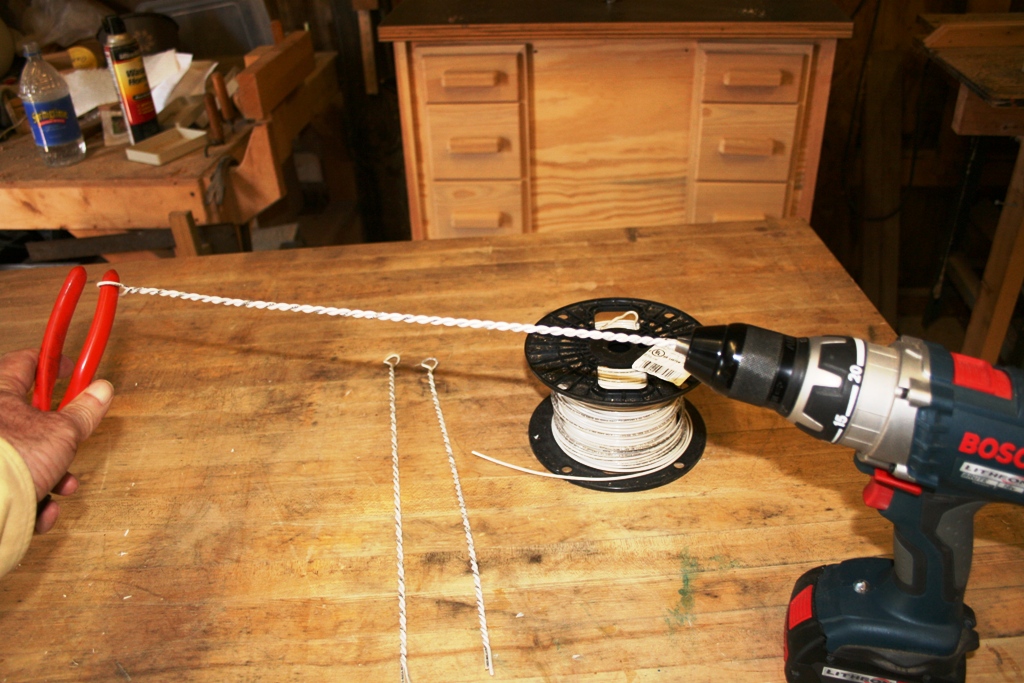
If you want to know how I make my twisted wires, here's how...
Get yourself a roll of coated solid core 14 gage electrical wire (or as much as you need).
Next, cut a piece about 40 inches long.
Next, double the wire in half and stick both ends into a drill and tighten the chuck around the wire.
Next, take one side of the handles of your wire cutters, stick it into the loop of the wire and pull it snug.
Next, simply hit the trigger of the drill and the wire will wind up. Don't over do it. All you have to do is make it snug.
Finally, remove the wire from the drill and you now have a wire that is plenty strong, flexible and will last for many years out on the racks.
The reason for so long a wire to begin with, it will shorten considerably when you twist it.
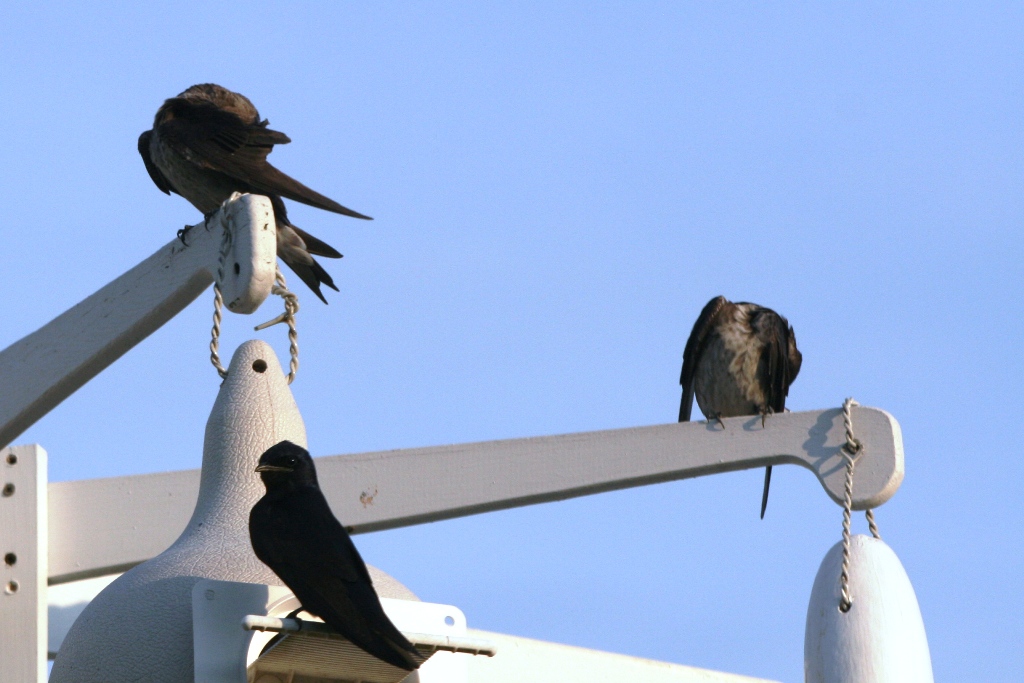
Now, when I hang them on the rack, (in my situation) I pass the wire thru the gourd, then thru the rack arm, thru the 'eyelet' in the wire and adjust it to where I want it. Then I run the wire up over the arm and twist the end into itself a time or two. The reason for this, if for some reason the eye part of my rack were to break off, the remaining wire over the arm will still hold it in place until I can repair the arm. It's just an extra added safety feature so I don't lose a gourd full of eggs or babies. Simple as that.