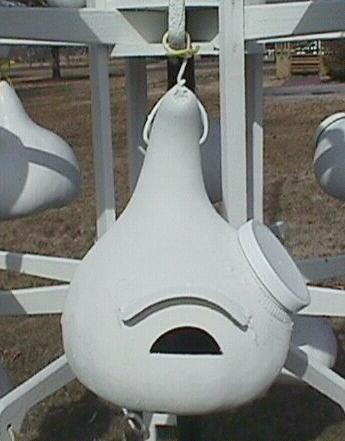
Anybody that's had anything to do with purple martins knows that, not only do they nest in man made tenant houses, but they also love to nest in gourds. And I guess because I use gourds, I get a lot of questions about them. Questions about how to either, acquire them, grow them or prepare them for purple martins. So much so in fact, that I decided to create a page just for gourds. When I first started looking into them for my own martins, I didn't realize they were so popular, especially here in the south. As I drove around the countryside, I would notice various racks or strings of gourds hanging in folks back yards, many with martins hanging all over them, so I guess they must work.
Therefore, in these pages I'll try to put as much information here as I can so everyone will have a clear understanding about them. To accomplish this, I will use information from other web sites, excerpts from books and/or pamphlets along with first hand knowledge from myself and/or others that grow them.
First,
I'd like to make one thing clear. I'm no expert on gourds and don't proclaim to
be. However, I have grown a lot of them, know a little bit about them
and use them primarily in my martin site. I just seemed to have better
results with gourds in my area than any other kind of housing. However,
another area of the country may have a whole lot better luck with tenant housing and in other places, the areas may overlap where both houses and gourds
will work equally well.
May I also add, most of the general growing and handling information contained here will
work for just about any gourd species, but the 'specific' information is going to pertain
to gourds used for housing purple martins. In our case, they are of the Lagenaria
family. If you're plans are to grow other kinds and want more information, there are many
other pages on the Internet that have information on gourds for other purposes. The American Gourd Society can be contacted
through their web page for specifics on other types of gourds.
Gourd Basics
The gourd family covers a broad spectrum of vined plants. It ranges from the edible kind, such as pumpkins, squash and cucumbers all the way through the inedible kind such as, well, hard-shelled gourds. That's the kind of gourds we're going to concentrate on. The dictionary describes these hard-shelled versions as: "any of various hard-rined inedible fruits of plants of two genera (Lagenaria and Cucurbita) often used for ornaments or for vessels and utensils."
Gourds are used for a number of different reasons depending on the type you have. Some are small and colorful with all kinds of weird and interesting shapes and usually used for ornamental purposes. These are usually a soft shelled gourd and you often see these in little ornamental baskets for decorations.
Some are intermediate sized and are used for bowls, pots, jugs and drinking vessels. These are often the favorites for artisans and are used for artistic purposes and most of the artistic crafts. You'll see a lot of these at gourd and craft shows.
Then
there's the larger sized that are basically used for birds houses. These
are the bottle gourds and are the
kind we're interested in. They are often called "bird house"
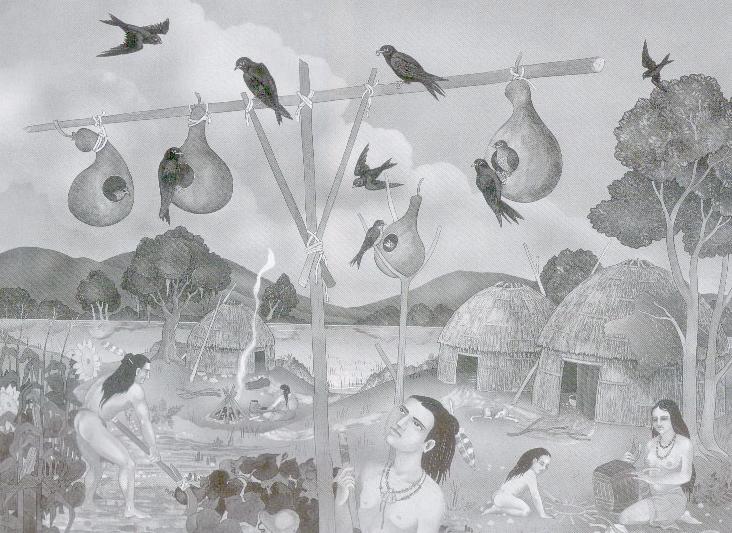
gourds because that's what the early Indians used them for. They
discovered that if they cut holes in them, cleaned them out and hung them in
trees or on poles around their gardens, birds would use them as a nesting site.
They quickly found that, as they put more of them up, if they could get a
certain kind of bird to use them, the insect population around the general
village declined. As the purple
martins discovered the gourds, they left the holes in the trees and usurped the
gourds as living quarters. Because the constant commotion around the gardens
kept other birds away from the gourds, the martins soon learned that being
around man was beneficial to them. Man supplied them with nesting sites, kept
other birds away from the gourds and they had places to rear their young thus,
the beginning of a long and happy relationship between man and the purple
martin.
|
| |
|
artwork courtesy J. Hill III |
|
Gourds & Purple Martins
Since the original
idea of this page is to tie purple martins and gourds together, the rest of this page
will primarily concern
itself with easy to build and inexpensive housing for martins. Housing
that is light, easy to work with and in just about anybody's price range and
best of all, it will attract purple martins. And of course, it will
consist of gourds.
Before we get into raising purple martins in gourds, if you are not totally
familiar with the rules for attracting and keeping purple martins and if you
have not already done so, I suggest you take a look at my Purple
Martin Page. It has a lot more details about martins that are not on this
page and may answer a few questions that you might have about keeping them.
There's one thing said there that I'd like to reiterate here and that's the
location of any purple martin
site. It should have a lot of landing room. Martins like to swoop into their
nests, and if there are any tall trees or other hindering obstructions close by,
it's going to be very difficult for the house (or gourds) to attract them. No structures of
any kind 'taller' than the martin house should be within 40 or 60 feet of the site.
Martins like a lot of room to enter and leave their site. However, this does not apply to 'human' housing. It
can be as close as 40 feet in some cases as long as it isn't taller than the martin housing.
Before erecting your site, think about a location for the site where it will be
free of hindrances for the martins when they approach the site. Things like
tall buildings and trees give an ambushing hawk the advantage of perching and
waiting on their prey and martins don't
like it and therefore; will seldom nest in such conditions.
Martins like to sit on phone wires, but if those wires are in the flight path to their nests, they now become a hindrance, thus a possible deterrence to martins nesting in your site. May not seem like much, but sometimes that's all it takes to make or break a site. However, if the martins decide that you have a good site location, then they will readily settle in and take up residence.
The
rack you see below if one of mine. I happen to have 4 of them in my colony
and I can assure you, the martins love them.

If you plan to supply gourds for martin housing, one of the things that will have to be considered is HOW you plan to offer them. There are many different options available ranging from long straight lines of gourds, ' T ' shaped poles, poles with metal wheels or old rake tines, and so on... I didn't really care for any of those so I decided to design my own. The system you see above is one that I designed and is one of four that are in my yard. I developed it because I just wasn't happy with the other forms of poles that were available. The following is why I decided to design my own gourd rack.
For years I'd tried to attract martins to my martin 'house' without success. They came, but never stayed. Then a friend suggested that I put up some gourds and bingo, I had martins move in the first year. However; not fully knowing what I was doing, I copied someone else's site and placed the gourds on a 'T' shaped pole that did not come down easily and therefore; maintenance was a very big problem. The pole was too high and I couldn't get at the gourds to take care of them. I even had some sparrows move into one of the other gourds, (again, not knowing any better) and I couldn't easily get to them to remove them. There just had to be a better way. So I went to my wood shop, sat down in the doorway and watched the birds and looked at the pole and thought about it. If I couldn't get up the pole to get to the gourds, then why not bring the gourds down to me.
Then and
there, I decided to come up with a system where I could mount my gourds and yet,
get at them easily to perform maintenance on them. At the same time I wanted
something that would be aesthetically appealing. I also designed in a pulley system that
really makes the whole thing happen. The pulley system is a block and
tackle design and will easily handle all the weight of the gourds and the martin
materials inside the gourds. Thus, the system you see above.
Now, I didn't come up with the idea of putting up gourds. I also didn't come up
with the idea of raising and lowering them. I just refined it to suite my
liking. I thought about a unit that would be quick and easy for
maintenance. I thought about somewhat low cost, structurally sound and
what I think to be attractive. I wanted the unit to also be easily accessible from
any direction for the
martins. Hence, the system you see above. The system is lightweight, but strong, and will mount 16 gourds on 2
layers on a steel pole. It's very easy to
care for. Everything to make the unit is readily available in your local lumber
yard and hardware store.
As for the gourds, they are usually available with a little inquiring around. In fact, here's some Gourd Suppliers. When you do order some gourds, purchase a few extra, sometimes they need replacing and it's always good to have a few extras around. If you really get into it, and you have the room, you can keep a few seeds out of one of the nicer gourds and grow some. As far as tools required to build the unit, all you will need is everyday hand tools the average person keeps around the house such as a jigsaw, drill, simple wrenches and pliers.
The
unit shown cost me approximately $100.00 to build and set up. Both natural
and plastic gourds can be used on it and since I grow many of my own gourds, that
helps with the cost. The cost may vary depending on the area, the price of
the materials for that area, and the amount of work you want to put into
it. And believe me, once you finally do get a
colony started, it will be worth every minute of work and every penny you spent
to just sit back and watch them as they effortlessly float through the air
eating insects and thus making life a little better for you.
If you want one, you can build one.
When someone suggested that I make plans for other folks, I decided, "why
not"? So, what I did was put together a small packet that explains all you need to know
to build a two level Purple Martin slide system and mount it on a pole and start your own
colony. All the instructions required to build and erect one of these units is
contained in the packet.
It includes a complete itemized list of materials, drawings and assembly
procedures for assembling the entire unit, instructions how to put in a ground
socket, put the pole up
and how to attach the slide and gourds to it. There's even a few maintenance
tips for the pole, gourds and wooden parts.
If you like the way my system looks and your interested in putting one up then
all the information to obtain the plans is located here. The
Rack Page
This system is very light and
I designed it so that it can easily be raised and lowered
by folks that may be slight in stature or maybe a little on the older side, like
me. There's no pinching of fingers like with telescoping poles. There's no
tipping of the gourds like on poles that pivot to lower them for inspection.
There's no climbing of ladders to get at the hard mounted systems thus making
things safer. All that's needed are a few basic tools and the know how to read basic drawings and basic
woodworking skills. Depending on the skill level, it takes
about one weekend to build one and assemble it. Painting depends on how
long the paint takes to dry.
One more thing. Just because you put up one of these poles is no guarantee that
you're going to get a Purple Martin colony. There are rules that have to be followed to attract martins to new sites
and the same goes for this structure also. It's young martins that overflow from
other sites that usually start new colonies because the older established birds will
return to the original house they nested in year after year, even the same nest
if possible. It might take some time to get a colony established. This is
something that's very hard to predict and sometimes, patience is a must. What you have to do is make the site as appealing as
possible to the martins and if they like it, they will stay. Mine
did!
This page created and maintained by Chuck Abare