Operating a purple martin colony is a very pleasant and self gratifying hobby. Few things are more soothing or relaxing than sitting out on the back deck in the evening and watching the superb aerial acrobatics of these delightful birds. They have a way a making a late afternoon breeze a thing of magic and their constant chatter keeps things lively around the colony. However, at times, it can also be very exasperating, due to having to deal with some of the pests and predators that bother them. However, if we plan to dip our hand into taking part of nature this close, then we are going to run into some of these problems. This page will make an attempt to deal with a few of those problems and pests.
I've been asked time and again, how can I feel so strong about keeping and raising one bird species and yet, advocating the capture and destruction of another. The reason is this.
In the late 1800's a man named Eugene Schefflin was head of a group of apparent nuts about Shakespeare. Being very 'well to do' and since these folks could afford it, they had 100 pairs each of all the birds that were mentioned in all the plays of Shakespeare shipped here to America from Europe. They then released them in Central Park in NYC. Not knowing much about the birds or their life styles, they were thrown into a completely different environment than what they were used to and all eventually perished 'except' the European Starling and the English House Sparrow. Having no natural enemies and now new and unlimited opportunities to nest, they propagated and flourished. From that time until today, both species have spread out across the U.S. Both are cavity nesting birds and, having no natural predators to keep them under control, they have propagated unchecked for all these years and their numbers have grown to the point that they are now a very big problem in this country, especially in the cities. In fact, with their being able to adapt to just about anywhere and raising 3 and 4 broods a year, the starling has now become the most populous bird in America today. Both the starling and the house sparrow have adapted to living next to man and his dwellings and find plenty of nesting cavities that suite their needs rather nicely. Likewise, because of their nesting habits and their very high numbers, they have devastated our own 'native' cavity nesting bird species. Both are very aggressive and are a threat to any cavity nesting bird they can 'trap' in their nests.
Many of our native cavity nesting bird species have suffered greatly because of these two species. Woodpeckers, Tree Swallows, Wrens, Blue Birds and yes, most definitely the Purple Martin. In fact, the purple martin has been hurt the most. Martins, being communal nesters, require condos to nest and propagate and because of their nature of leaving the colony to feed, the sparrows and starlings often slip into their unguarded nests and do their dirty work, destroying eggs, young and even an occasional adult that happens to become trapped in the cavity.
Both of these species, although operating differently, will eventually end up with the same results, destroying the eggs and broods and usurping the martin's nest.
Starlings:
When the martins are away, starlings will destroy any eggs or young they find in the nests. Often, if a starling is able to capture or trap an adult martin in its' cavity, they will even kill them. If you have a martin house, then this sight alone is enough to make anyone learn to hate these pests. Martins are a gentle bird species and are no match for a starling in a 'one on one' fight in a closed in cavity. Once they evict the owners of the compartment, they often slip from cavity to cavity, destroying the eggs and young in the other cavities. They then settle back to wait on the returning martins and when they eventually return, the starlings will drive them away, preventing them from nesting in the house. Often times, a single pair of starlings will take over an entire martin house and prevent its use by any other bird. In fact, I have personally seen where a pair of starlings have built their nest right on top of baby martins that weren't even dead yet. It's not a pretty sight for anyone to see.
Sparrows:
Likewise, the sparrows will eventually do the same thing. They first acquire a cavity and immediately begin filling it with grass. Sparrows are a member of the weaver finch family and will put anything in their nest that they can. Hay, grass, roots, weeds and a lot of feathers. Feathers are very prized by the sparrows and can often be used as bait to capture them. They pack so much in, in fact, that no other bird will enter. Often, you can see the excess material coming out of the entrance hole and if given enough time, this material will even push the front doors off of some houses. Once they are settled in, they too go from compartment to compartment, 'pinning' (pecking holes) in the eggs in the entire house. This destroys the eggs and of course, the clutches for the martins. Both species do this to prevent the raising of other bird species' young so that there is less competition in the future. Sparrows will eventually fill all the cavities of the house, making it un-inhabitable by martins. So, the next time you feed one of these two pest birds a McDonalds French Fry or a piece of bread from a hamburger, just remember, you are somewhat helping in the destruction of some of our own native bird species.
The following is a little more detailed look into the problem you'll have around a martin site...
Flying Pests
Once you put your
house up, European Starlings and English Sparrows are probably going to be the
first major problem you run into. They can quickly become a major problem around
any martin site, especially if it isn't well established. They bother the
martins by destroying the eggs and young and taking over the nesting cavities.
It doesn't matter what type of housing you have, if a starling or sparrow
decides it wants to nest in it, it will. Different areas of the country are
bothered differently by these pests. Some places don't have any at all
while others, like here in Northern Alabama where I live, it is inundated with
these pests to the point that they have practically driven the other cavity
native birds out of the area. The following are my thoughts and comments as to
the control of these two bird species.
May I also interject something here. I have as great a respect for nature as
anyone else, and under normal circumstances, I will usually let things happen as
nature intended. I don't kill snakes simply because they're snakes.
Instead, I put the proper measures in place to protect my martins.
However; this
starling/sparrow problem is one situation I feel needs some help in being
controlled. As stated above, European Starlings and English House Sparrows have become a major problem to the other native
birds here in North America. I feel that capture and destroying them is the only sure method of
control. Once captured, the method of disposing of them is up to you. If
you are not able to dispose of these two pests, then I suggest you not get into
the martin hobby. You will only be helping them out and believe me, they
don't need any help at all.
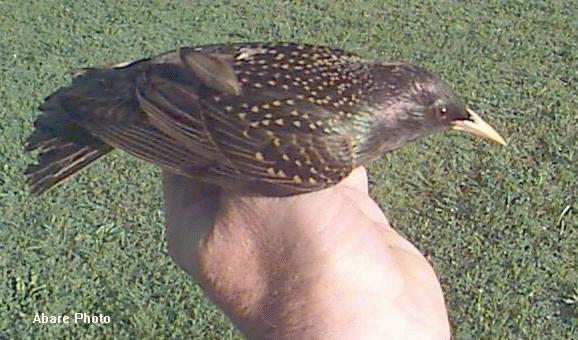
Starlings: The
European Starling.
The European
Starling is a very aggressive bird in comparison to the Purple Martin. They can
be seen just about anywhere in large groups, usually on lawns and road sides,
digging for grubs and ground based insects. Because of their nature of foraging
for food, they have developed very strong beaks and body muscles and can inflict
major damage on adult martins, their young and eggs, and even YOU if you're
fortunate enough to get your hands on them and aren't careful how you handle
them. In areas where they are a problem, a trap will have to be set up for
them or they will not let the martins nest. Even though the potential
landlord watches and drives them away whenever possible, they will still come
back the minute his or her back is turned. They are very persistent and just will
not give up once they decide they want to nest in one of the cavities.
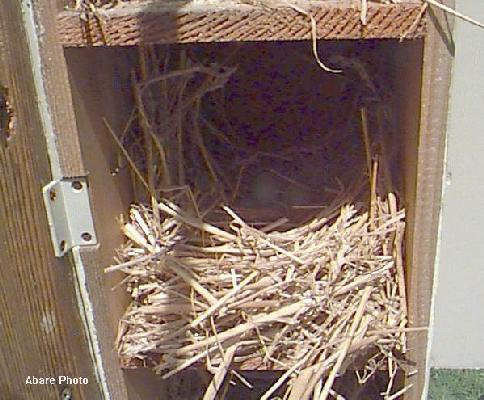
A starlings nest
will fill the nesting cavity more than a martin's nest, and they will have a
very deep bowl in the back of the compartment with material flowing up the sides
of the cavity. Starlings do not use mud to make a dam in the front of their nest
like martins do. This is one of the easiest ways to discern which type of nest
you are dealing with.
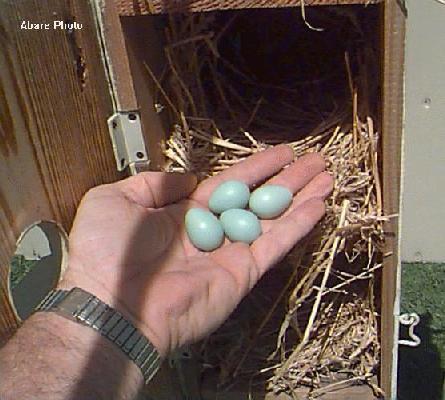
Starling eggs are about the size of a Robins egg and are powder blue. Usually
there are 4 or 5 in the normal nest. These differ greatly from martin eggs which
are pure white and a little smaller.
As I stated above, starlings are a very aggressive species of bird, and in close
quarters, the martin is no match for them. Their destruction is total and if they can capture a martin in their
nest, they will often kill the parent and baby birds by pecking them in the
heads. Yes, it does sound bad, and it looks even worse. It is very disheartening
to look into a martins' nest and see this shocking picture. And, once you've
seen it happen to one of your martins, I'm willing to bet you won't have any
problem disposing of any starling you get your hands on.
Fortunately, for us, there are a number of different methods to control these
pests. If you have a small site, for instance, only one house or a few gourds,
you can purchase a small trap that will fit inside a hole and trap the starling
inside the unit until it can be dealt with. If you own a larger site with 20, 30
or even more nests available, you may have to come up with a little more drastic
measure.
That was my problem. The starlings were taking over both my martin house and my
gourds, and no matter how many times I removed them, they simply built another
nest. I was getting very frustrated with the whole situation and was determined
that I was not going to let these pests defeat me.
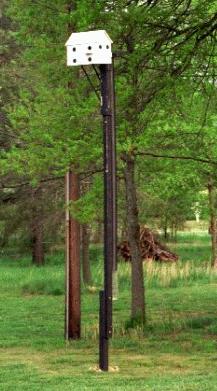
So, I acquired the plans for a Troyer S&S Controller and built me one. Then, carefully following the instructions, I set it up near my site. As you can see, it looks just like a small purple martin house. The unit is designed with a self setting trap inside of it. It works like this.
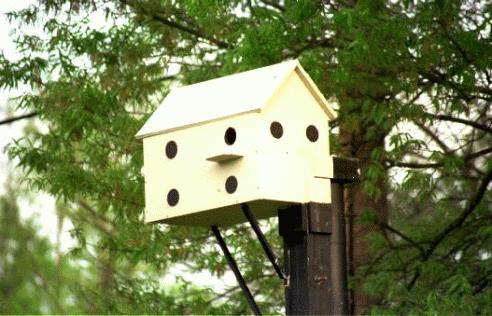
There is a hole in the front of the unit for the starling to access. Upon
entering the unit, the starling trips the trap, (The idea for which is so
simple, I think it's ingenious). The starling is then forced to exit through a
hole in the rear of the house and is delivered to a basket near the ground via a
tube down the back of the unit.
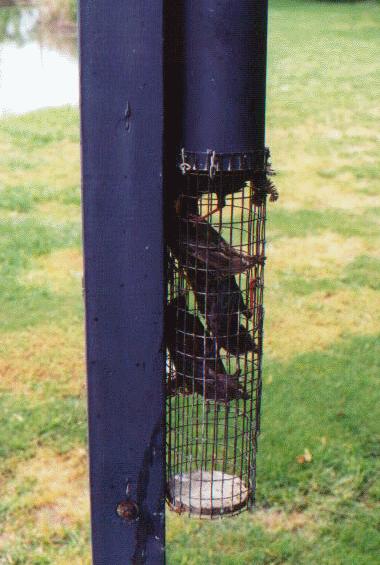
Here the landlord can access the birds, and again, although this sounds cruel,
if they are one of these two pests, I strongly suggest destroying them.
Relocating them is a waste of time and effort. Birds have a very good
homing instinct and will be back at the site before you even get home. I once tested
this by tying a string to the leg of a starling that had been bothering me at my
site and then driving it about 7 miles away and let it go. I'm not kidding
when I say it beat me back to the nest site. And besides, if you were to
drop them off somewhere else, you would just be giving your problems to someone
else down the road. Starlings raise three, and sometimes four, broods a year and native
migratory birds just can't compete with them. Their numbers have become so
numerous that they can be seen flying in large flocks that literally take 5 and
10 minutes to pass over head. My own personal feeling is that if some
major control method isn't initiated nationally, they will soon wipe out a
number of native species of cavity nesting birds in the very near future.
And it's not just the native bird issue. Many farmers have expressed the
problems these birds create with grain industries, contaminating the grains and
of course, making it unusable for human consumption.
Once you have one of these units set up, all you have to do is keep an eye on
the basket and dispose of the starlings whenever one is deposited to the basket.
When the bird leaves the trap part of the unit, it automatically resets itself
and is ready for another starling.
This unit worked so well in fact, that I built me a second one. I'm not going to
brag on the numbers I've captured, but within a month and a half, my immediate
area was practically starling free. It really is a good feeling to know that I
don't have to worry about these pests bothering the martins anymore.
One other thing. Should a desirable bird happen to trip the trap, all you have
to do is open the cage door and let it go, unharmed.
Sparrows: The
English House Sparrow
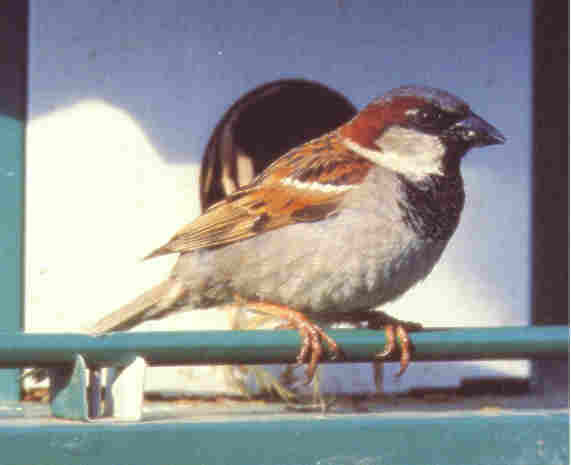
English House Sparrows are another bird species that will eventually become a problem around a martin site. Many sites around populated areas can become infested with them. They particularly like the aluminum houses. The compartments seem to be just the right size for them and once they initiate nesting, it is just about impossible to get rid of them.
This cute little fellow here is also a wolf in sheep's clothing. He may be cute,
but he is also very aggressive once he gets situated in one of your martin house
nesting cavities, and although usually not much threat to the adults themselves,
these birds will attack the young and eggs and then take over the nesting
compartment. If you find a pile of martin eggs on the ground, then you can bet
it's the work of one of these fellows. And, if he gets himself established in a
nesting compartment, be prepared to tear it out time after time. They too
are very determined and persistent and will rebuild as many times as you tear it
out.
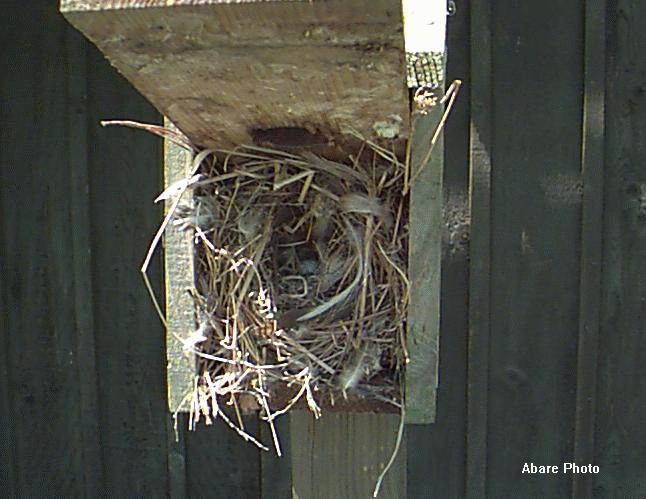
You can easily tell if sparrows are nesting in your house or gourds because their nest
can be immediately recognized over another birds nest. Sparrows are a member of
the Weaver Finch family and literally fill the
nesting cavity from top to bottom with grass and feathers to the point that it
will be coming out the front entrance hole. They leave only a small tunnel for
access into the nest. If you look into a cavity and see
this, you've got sparrows.
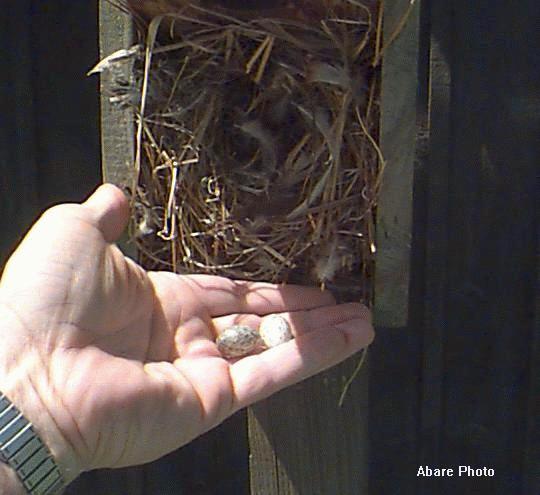
Sparrow eggs are much smaller than starlings and martins. They are a sandy brown
with dark brown specks all over them. There will usually be from 2 to 4 in a
normal nest.
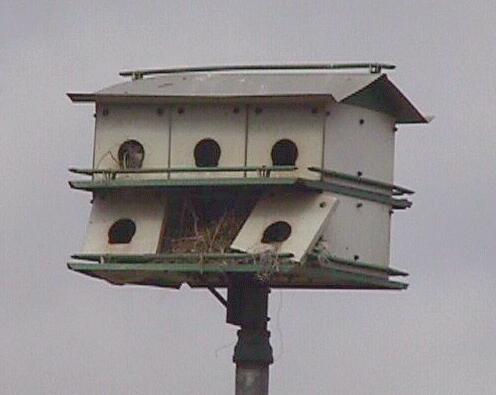
The aluminum house above shows what can happen when these little pests are left unchecked. They will clog the compartments with so much nesting material that the doors will no longer stay attached. Although not real clear, you can faintly make out the male in the upper left hole guarding his compartment.
And, if you think it's OK to let them nest in your martin house, then here's what you should expect to see in your martin's nest.
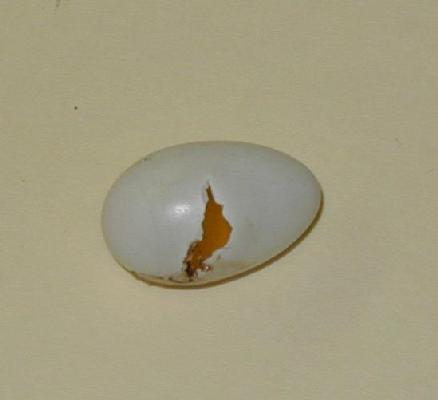
Sparrows are notorious for entering a martin nest when the martins have left to feed and "pinning" the martin eggs as shown above. This obviously renders the eggs useless and of course they won't hatch. This cuts down on the number of martins and in turn cuts down on competition for future nesting sites. They have also been known to kill young that have been left unguarded.
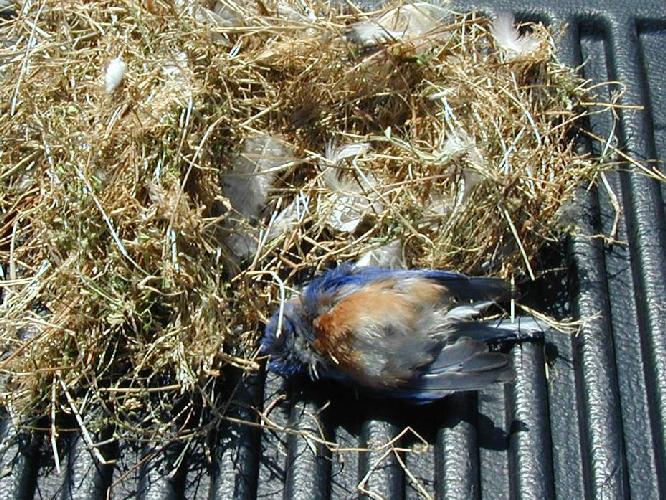
And one more thing. DO NOT believe that these 'cute little birds' are not a threat to other native cavity nesting birds in your area. Here is a picture of a Bluebird that I found in its' nest with 3 eggs and a sparrow had built its' nest right on top of it. The bluebird was pecked to death in its' own cavity while trying to defend its eggs.
Eliminating them:
One of the major discoveries in the last few years to control the starling infestation is the crescent shaped SREH's. (Starling Resistant Entrance Holes). These holes are just a little smaller than the height of a starling's sternum and under most testing, 99% of all starlings are kept out of martin housing. Below is a picture of one of my gourds that a starling pair found attractive enough that they tried to get into it for over 2 weeks without success. As you can see they actually pecked away all the paint trying to enlarge the hole so that they could enter. This was a gourd that originally had a round hole and I changed it to a crescent shaped hole with a simple add-on. My entire site is now crescent holes. If starlings are a problem around your site, this is one of the first things you should look at. Starlings hate them. There are a number of different styles now available from different manufacturers and if starlings are an issue, I suggest you look into them.
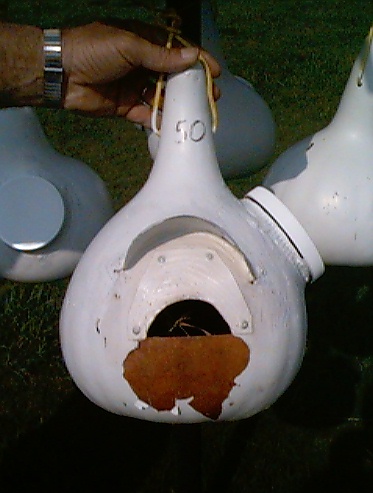
Not only do crescents keep out starlings, but they now help keep out other predators as well. Providing the compartment is deep enough and the martins have a chance to back out of the way, many of the predators that could originally enter the 2 inch hole, will now be foiled. Jays can no longer get into the compartments. Nor can squirrels, (without chewing it bigger), crows, owls, 'coons or gulls. All are too big to get into the smaller SREH. If any of these other critters are a potential threat to your colony, then I strongly recommend your changing to SREH's.
Other methods
Here are a few other
things that you can do to help eliminate these pests. Depending on the
type of housing you have, there are a number of different traps that you can
acquire that can keep these pests under control.
There's a wire cage called a Repeating Bait Trap. With the correct
placement of this trap, you can catch sparrow after sparrow. It is also self
repeating, working pretty much on the same principle as the S&S Controller.
The birds are kept alive and unharmed until you deal with them.
If they are bothering a wooden house where the front is removable for access,
there's a simple little trap called the Insert Trap, that you
attach inside the access hole and upon entering the house, the sparrow is
trapped until you retrieve it.
If you have an aluminum house, they have a device called a Spare-O-Door.
Again, the sparrow enters the house, is trapped and held in a plastic bag until
you retrieve it.
And, if they are bothering your bluebird boxes, they have a Nest Box Trap
that has the INT-1 installed in it to catch the ones that won't leave
your bluebirds alone. All you have to do is temporarily replace your bluebird
box with it until you catch the sparrow, then replace your bluebird house.
All of these traps catch the birds, and then hold them, unharmed, until you deal
with them, and you already know where I stand on that issue. But, if you just
can't seem to bring yourself to dispose of them, and you want to get in your car
and drive them as far as 20 miles to get rid of them, so be it. But you will
quickly find out that the birds will beat you back to the house.
OR...you'll only be dumping your problems on some other guy down the road.
It may take a little
effort on your part, but these pests can be controlled, and believe me, it's
worth it.
Woodpeckers
Although these birds aren't usually a threat to the martins, what they do is ruin a wooden martin house by pecking at and enlarging the entrance holes. Squirrels will do the same thing by chewing the holes larger. I've also had this happen on my S&S trap holes and my Bluebird houses. One thing that can be done to prevent them is to sandwich a piece of 1/16" thick aluminum in between two pieces of wood. If the woodpeckers have already destroyed the house or you are building a new one, here's what's done. First, a new piece of wood has to be put back on to replace the one that was destroyed. This might mean a new front face or a new door depending on what you have. Now, cut yourself a 3 inch square piece of 1/16" thick aluminum. In the center of it, cut a hole the size you need. Hole saws that fit in your drill are made of steel and will easily cut the hole in the aluminum. If you do this, use a pair of pliers to hang onto the aluminum sheet so it won't spin and cut your fingers. In each corner, drill a small hole that will allow mounting screws to pass through. Now, make another piece of 3 inch square wood, exactly the same as the aluminum by match drilling the holes. Now, screw the new piece of wood to the front of your house with the aluminum sandwiched between the two pieces of wood. When the wood pecker pecks the front piece of wood to open the hole, it hits the aluminum and can go no further. Although the outside hole is opened up considerably, the inside piece of wood is safe from the pesky woodpecker. I've had to do this to my S&S's and it works great. Plus, all the roughed up opening the woodpecker created makes for great claw holds for the proper tenants.
Snakes, Raccoons,
Squirrels, etc:
Another problem that you will eventually run into is climbing predators. Snakes,
Raccoons and Squirrels all love birds and bird's eggs. You can throw the
friendly family cat in this category also if they have a tendency to climb. One visit by one of these critters
will devastate a martin colony, especially if it's small. Sometimes the parent
birds will get away, but any eggs or young birds will be lost. Yes, that cute
little squirrel will snatch an egg faster than you can blink an eye. He will
also chew the entrance holes of a wooden house or gourd to beyond recognition
just to get at the contents inside.
Raccoons will physically tear an aluminum martin house apart trying to get at
the occupants. The tell tail signs of destruction are often the work of 'coons
that have scaled your pipe and gotten into your martin house. Gourds are a
little more difficult for the 'coons to deal with because of their
swinging. This swinging makes the 'coons feel uneasy and makes it difficult
for them to get at the contents. However, the swinging DOES NOT prevent
them from gaining access. If they are able to pull the gourd up to where
they are, they will then proceed to tear the gourd apart to get at the contents.
Snakes are another problem. DO NOT BELIEVE THAT SNAKES CANNOT CLIMB A STEEL
POLE. In fact, they make it look easy. They are hardly even noticed
slithering up the pole and once they gain the top, simply slither right
in. Once they've obtained access, they don't leave until ALL occupants
have been consumed. Some snakes are unbelievably good climbers when there is a meal
at stake. We normally don't think that they can go up the surfaces of a smooth steel
pole, but take it from me, I've personally removed snakes from many martin
houses (much to the chagrin of the landlord that thought they couldn't climb a
smooth metal pole). Although not all snakes like to climb, there are a few that have
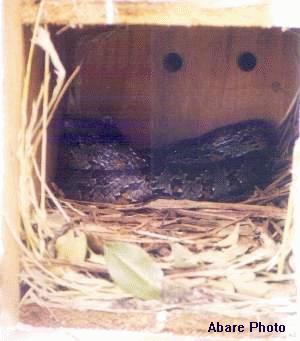
no problem with it at all. The rat snake pictured below will readily and
willingly clean out your martin house or gourds if given the chance. As you can
see, we found this one in a T-14 compartment after it had feasted on the 4
chicks that were in it, and it was settled down to digest them before moving on.
The T-14 is on an 18' high steel pole and at the time, didn't have predator
guards. It does now.
So what can be
done about these types of predators?
Believe it or not, these climbing predators are the easiest to keep from your
site. Just put up a good working, climbing predator guard. There are many
different styles available. You just have to decide which will work for you,
purchase or make one, and then install it on the pole to your housing. If
properly installed, it will prevent any climbing creature from gaining access to
your housing by not allowing them to climb the pole. Here's the link to a
simple one to make and use. A
simple snake guard. I strongly suggest making one and then using
it. As can be seen on that page, they work.
Flying Predators:
Owls, Crows, Coopers and Sharp shinned Hawks and even Blue jays will wreak havoc
at a Purple Martin site. These flying predators are interested in both the
parent birds and the eggs. Depending on the size of the colony, one successful
visit by one of these flying bandits will bring many more and before long, the
site could be considered destroyed. The parent birds that escape will quite
often abandon the site, never to return.
Owls are probably the hardest to defend against out of these predators. They are
a very large and strong bird and can be very destructive in their attempts at
getting to potential food. They
usually hit at night and will quite often do their work without your even
knowing they were there, until it's too late. Often, the only way you will know
they've been to visit is from the tell tale claw marks all around the entrance
holes or maybe a feather or two on the ground. Sometimes, you'll notice the front
of a gourd that's been pulled off if it's not a quality thick walled
gourd. That, and the parent birds will be gone.
Owls will often tear off the porches and some doors from aluminum houses.
Crows and Jays can become bothersome pests also. They try to get at the eggs
and/or young. Although not usually destructive to the housing, they can also
cause the site to be abandoned.
Hawks can become a major problem, especially when the young are just fledging and
learning to fly. The parent birds are very good flyers, and can usually out
maneuver these predators, but the young, inexperienced birds often fall victim
to them. These predators will hide in any nearby tree and then ambush any
inexperienced martin that happens by. This is one major reason martins don't
like to nest within a close proximity of any large or tall trees.
What can be done to prevent these flying predators from getting at your
martins?
Prevention in this case will depend on the predator. Coopers and Sharp
shinned hawks usually attack from an ambush point. This means they'll hide
in or come flying around a strategically located tree and surprise the martins
and before they have time to react, one sometimes ends up in the predator's
talons. This is why our housing has to be located at least 60' from any
nearby tall trees. One way to keep them away, hawks don't like humans, so
being outside and around the colony site will keep them away somewhat. At
least they won't settle in any nearby trees. But they will still quickly
fly in, trying to surprise the martins, making them panic and thus; picking off
any that gets disorientated.
Owls are located
everywhere throughout the purple martins' range. If you have some form of house, then
there are guards that can be installed that will prevent these birds from
gaining access to your housing. Some of these can be purchased if you have a
standard aluminum house. If you have a custom house, then you may have to custom
build one for your particular housing requirements. These can be built
using a standard 4" page wire that can be purchased at any farm
supply store.
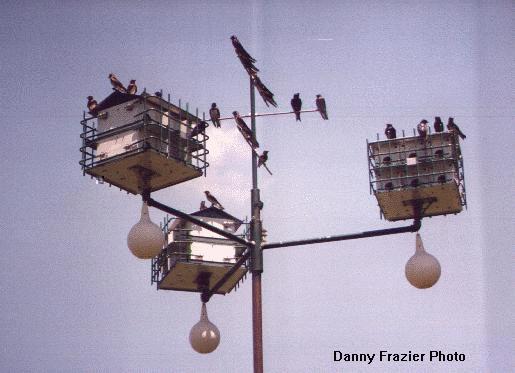
Below is a picture from Danny Frazier's site in Oklahoma showing owl guards mounted
to his martin houses. As you can see, the martins are very adaptive birds. Once
they get used to the guards, they don't pay them any attention at all. In fact,
they even use them to rest in.
NIGHT LIGHTS
Many times I've heard that night lights have helped in keeping owls away. I can't personally speak for this, but many folks have written and said that 'night lights' have been the answer to their owl problems and I have no problem at all with passing on information that works. One particular email said that these night lights have solved their owl problems. They added one to the top of each of their poles and then the owl problems apparently went away. Since they are solar, there's no need for electrical wires. This just might be the solution for your owl problems.
If you have gourds as your housing, they too, can be protected. Owls attack by normally landing on the rack and listening for noise coming from inside the gourds. Martins make a lot of noise at night and owls can hear this. Once the prey is located, they fly down and hover in front of the selected gourd, reaching out to grab the entrance hole with one claw. They then use their wings to beat on the sides of the gourds, (thus the reason for finding owl feathers on the ground after an attack), spooking the martins to take flight. When one tries to exit the gourd, the owl snatches it with the other foot and then flies off to a favorite perching spot to feed. Once successful, they'll return time and time again until all the martins are gone.
It was once thought that gourds that swung freely would help do a number of things such as prevent starlings from nesting in them, but that statement has absolutely no merit. Likewise, the swinging of a gourd does absolutely nothing to prevent an owl attack. My gourds swing freely and have been attacked numerous times by owls at different times. However, if an owl is unsuccessful, they will usually fly off and look elsewhere for easier prey which is what happened at my site. Owls will not waste precious energy on failed attempts at getting food, they will usually simply move on to easier pickings.
So, what can be done to prevent owl attacks. First, an owl has to be prevented from hovering and gaining access to the gourds. If they can't hover or reach out and grab the gourd, then they can't get at the martins.
Again, the page wire can be utilized to make a baffle of sorts (umbrella style) where the martins can slip through, but the owls can't. A second option is to attach aluminum rods to the rack arms and then bend them in a curved shape down in front of the gourds, keeping them about 15" to 18" in front of the gourds. The idea is to prevent the owl from hovering in front of the gourd by getting in the way, thus preventing the owl from getting a foothold on your gourds.
And, although this hasn't really been tested, I use crescent SREH's and one thing about them is that they are very tight in size and a martin has to squeeze through them to begin with. If an owl grabs hold of a gourd by the crescent, it's claws fill up much of the hole, thus doing two things. One, it prevents the martins from being able to exit the gourd thus, actually protecting the martin in its gourd and two, it prevents the owl from successfully getting at the martins. Because of the fact that crescent SREH's are new and it's hard to predict when an owl will come to visit, it's hard to do research on this thought. But, I use crescents exclusively and I also know personally that owls have come to visit my site on numerous occasions and as per my records, I have yet to lose a martin to them.
Purple
Martins are bothered by a variety of insects and parasites. These parasites have
to be controlled if the parent birds are to raise large and healthy broods.
Again, where you live will determine the type of pest problems you'll have. We
won't try to discuss them all here, but we'll attempt to express what can be
done about the major ones.
Mites, Lice, Fleas and Blow flies are some of the major concerns most landlords
run into. These parasites live in the nesting material and feed on the young.
Most of these can be controlled with diligent nest checks. When found, they need
to be tended to.
Mites, Lice:
Mites are small parasites that stay in the nesting material in the nest and live
off the young. They are usually brought into the nest by the parent birds when
building the nest. They are found just about everywhere.
Lice usually live out their entire lives on the birds themselves, so there isn't
too much that can be done about them other than to supply fresh nesting
materials to allow the birds to be more comfortable.
One thing you may have read is that putting cedar chips in the
compartment will slow the infestation of the mites. Sorry, but my testing shows
that cedar chips do nothing to prevent mites. In fact, my martins actually
threw them out of the nest in favor of a more stable nesting material such as
pine or wheat straw.
Diatomaceous Earth:
I've tried DE. Unfortunately, I've found it just didn't work. What is recommended to do with it is sprinkle it around the outside edge and under the nesting material about 10 days after the young have hatched and again about 10 days later, keeping it away from the center of the nest so the birds won't peck at it and ingest it. If you want to try it along with nest replacements, Diatomaceous Earth can be found at most garden centers and Co-ops, and is supposed to work by breaking down the exo-skeletons of the insects allowing them to dehydrate. It's also recommended that nest changes be done along with it's use, but I've also found that the nest changes alone do the same thing. And...once the DE gets wet, it turns into a wet mush, thus not being able to do what it was intended to do.
UPDATE:
It's
recently been discovered that DE is a possible carcinogen
and is not 'NOT' recommended to be used in martin nests.
Fleas:
Fleas are pretty much self explanatory. Everyone has run into them with their
family pets. Unfortunately, they are not as easy to control on and around birds
as they are on cats and dogs.
No, don't use 'flea spray' and spray into a birds nest to rid them of fleas.
It is poison and could harm the young if they breathe in the vapors or ingest the dead insects.
Blow fly larvae:
Blow fly larvae can become a problem around hatching time. Blow flies lay their
eggs in the nesting material and when they hatch, they survive by sucking the
blood from the young.
Fight Back
Nest replacement. If you plan to treat your pests by replacing the
infected materials, here is how it's done.
Make a small temporary nest in a
small box or bucket. Use dried lawn clippings for the nesting material or simply
use paper towels. Both are soft and won't harm the young birds. Place the young in this temporary nest. Now
remove all the infested nesting material from the nesting compartment.
(Some folks use a spray bottle an spray the insides of the compartments with
alcohol. It kills any remaining mites and will quickly evaporate).
Replace the original nest with new material, making a 'bowl' towards the rear of the
nest approximately where the original bowl was. Make
sure there is enough material to separate the young from the compartment floor.
Now, simply replace the young and close up the compartment.
Replacement materials can consist of wheat straw, pine straw, (pine needles).
Don't use grass clippings, they will absorb water and stay wet. You may want to keep some
extra nesting material in a plastic bag to use just
for this purpose. Doing nest replacements will also teach your birds to trust
you. The young will learn to accept being handled and will fear man less than
birds that are not tended to on a regular basis. This is one major reason
that you need to be able to easily get at (and into) your housing. And, if your housing
does not facilitate easy nest replacement, it should be reworked so that it can
be done. Remember, this is a hobby, and it is supposed to be fun, but you are
working with live creatures, and you need to be able to do whatever is required
to protect them.
Sevin Dust, Sulfur, Etc;
Authors Note:
There is much controversy on the use of pesticides to control insect pests in the nests of purple martins, therefore, I will not "tell you" to use any pesticide of any kind, especially anything from a spray can. Improper use could result in harming your birds. Other than here, as of this date, there is no approved method in print from an approved source (major martin organization) that talks about any pesticide use.
However, I will tell you "what I do" and if you want to try that, then fine, but I will not be responsible for someone's misuse of a chemical and harming their birds.
What I do not do:
I do not use Sulfur. Sulfur is caustic and can burn a young birds skin and eyes.
I do not use any kind of chemicals out of a spray can. They are much too uncontrollable. Most are direct poisons and will harm young birds.
What I do:
When mites infest my colony, I do this. I take a level TEASPOON of 5% Sevin dust and sprinkle it 'on the nesting material' just inside the entrance hole. I simply stick the spoon thru the entrance hole and slide it from left to right, as if I were sprinkling sugar on my morning cereal. Mites travel in and out of the nest by way of the nesting material and in doing so, they pass through the Sevin dust, and when this happens, the Sevin gets on their skeletons and kills them. Also, the comings and goings of the adult birds gets some of the Sevin on them and spread it throughout the nest. This also kills any of the mites on them as well as the young. Usually, the treatment eliminates the mites within 24 hours and only one treatment a year is required. As with any chemical, more is not better. Give it time to work the way it was intended. Sevin was formulated to work in the poultry industry just for this reason, to rid the poultry of chicken mites, but it takes about 24 hours to work, so once applied, be patient.
And one more note:
It does no good to 'pre-treat' with Sevin dust. The active ingredient (Carboryl) will only last for about 3 days once subjected to the air and sunlight and thus; becomes inactive. Therefore; treat only when mites are detected in the nests.
Ants/Fire
ants:
Although not usually a major problem (except in the deep south) fire ants have been around for eons, and are part of a landlords nightmares if
plagued by them, especially the fire ants. This is a new predator that is
becoming a real problem in the Southern part of the purple martins' range. They
will climb the pole and kill the young by feeding on them. (Ants eat only
liquids). Once found by a
foraging ant, the young are doomed, and stop to think of what kind of death this
is for the young that are totally helpless to defend themselves. The ant leaves
a chemical trail that all the other ants can follow, and soon the young are
totally destroyed by the ants.
Also, we've probably all had this happen to us at one time or another. You wake
up one morning and find sugar ants running across the counter in YOUR house and
you can't figure out where they're coming from. Off you go to get a can of ant
spray to get rid of them. Remember, some of these are very small and will fit
through the smallest of holes, and if there's one to the inside of your house,
sooner or later they'll find it.
There are a few things that can be done. Petroleum jelly can be added to the
pole and it will effectively repel the fire ants for as long as it lasts, but
the ants have to be dealt with as soon as possible. As soon as the jelly is
gone, the ants will be up the pole and will kill the young. And...since
the pole is usually hollow, they can use the inside of the pipe to gain access
to the house and we can't treat that.
One
treatment that works is to break open the top of the hill and then sprinkle some
Acephate on them. Ants are very meticulous and will clean each
other off and thus, will eliminate them, including the queen, but be careful.
This is a strong poison and MUST be kept out of the reach of any children
or family pets. It will kill them. This chemical works very
well to control fire ants and will usually kill the hill within 10 to 12 hours.
Also, here's another little something that might put an end to all your sugar
ant problems, both inside and outside.
Note:
DON'T LEAVE THIS WHERE PETS AND KIDS CAN GET AT IT IN ANY LARGE AMOUNTS.
Mix 10 oz of KARO syrup, 1/2 cup of water and 2 teaspoons of Boric Acid in a
container. Stir well. Now place some of it in areas where the ants are a
problem. For instance, if they are on your counter, place a few drops on a small
piece of cardboard such as the kind that form the bottom of a small GEM's donut
pack, then place it 'IN' their line, and let them go. I know this is hard to do,
but don't kill them. They need to ingest it and take it back to the colony and
the queen. Some of it is fed to the queen...end of sugar ant problem.
Same thing outside. Use some aluminum foil that is formed to make a small but
shallow tray and place a teaspoon or 3 of it in the tray. You could even use the
spoon to form the bowl part of the tray by forming the aluminum around the round
part of the spoon. Place it at the bottom of the martin pole or where ever else
you're having the problem. If you do it right, the aluminum foil can be formed
around the pole and they can't get up the pole without finding the syrup. Then
put a couple of teaspoons full around the tray. This can be used anywhere you
see them. Just remember, whatever you do for your container, make sure they can
get to it and then get back out. You don't want them to fall in and drown.
Unless this gets to the queen, there will just be more and more coming looking
for food.
What I've tried to do here is give you a basis to work with for protecting your
martins. Depending on where you live, I'm sure there are probably other types of
predators and parasites that could do damage to your martin site. And, depending
on your predator problems, you may even have to come up with another type of
solution. If so, give the situation some thought as to how to solve your
particular problem, then go for it. Remember, 'necessity is the mother of
invention'. Just make sure that whatever you do will 'protect' your birds and
not 'harm' them or any of your children or pets. If it's a poison, then use it
intelligently and don't overdo it.